Japan × Italy. Engineering a healthier, longer life.
From medical devices to tissue models and new ways of seeing inside the body: our report from the Japan–Italy healthy longevity forum in Osaka.
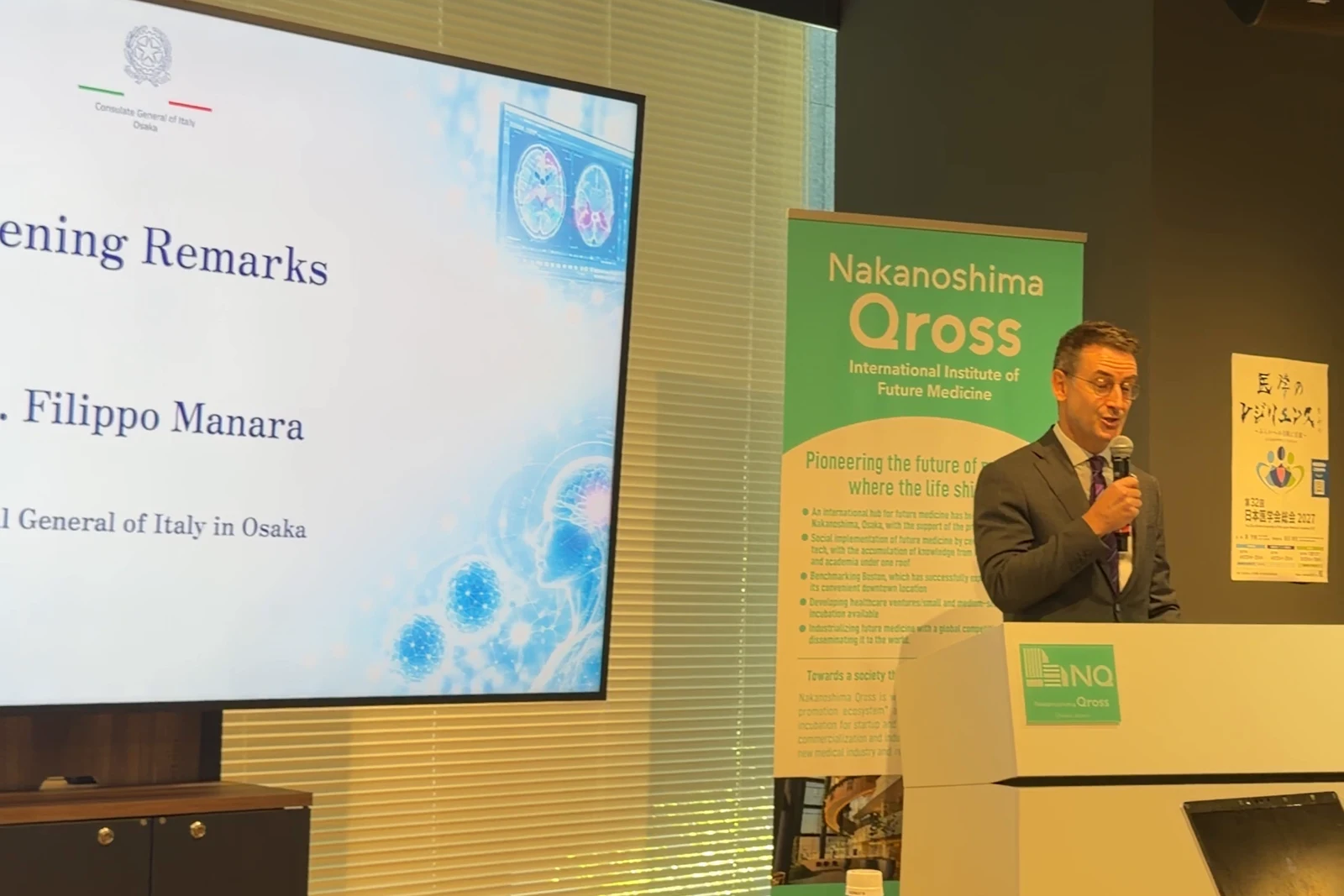
Back at Nakanoshima Qross
What helps turn a longer life into a healthier one? On 6 November, YOTSUBA JAPAN returned to Nakanoshima Qross to hear that question explored through medicine, engineering and international exchange.
We attended the Healthy Longevity and Biomedical Engineering Innovation Forum at Qrossover Lounge Yume. Organised by the Consulate-General of Italy in Osaka, Nakanoshima Qross and Professor Giuseppe Pezzotti, it marked 160 years of diplomatic relations between Italy and Japan.
Our recordings bring back the atmosphere of the room: opening remarks, research presentations and a succession of questions about how technology might help preserve health and function.
A forum for healthy longevity
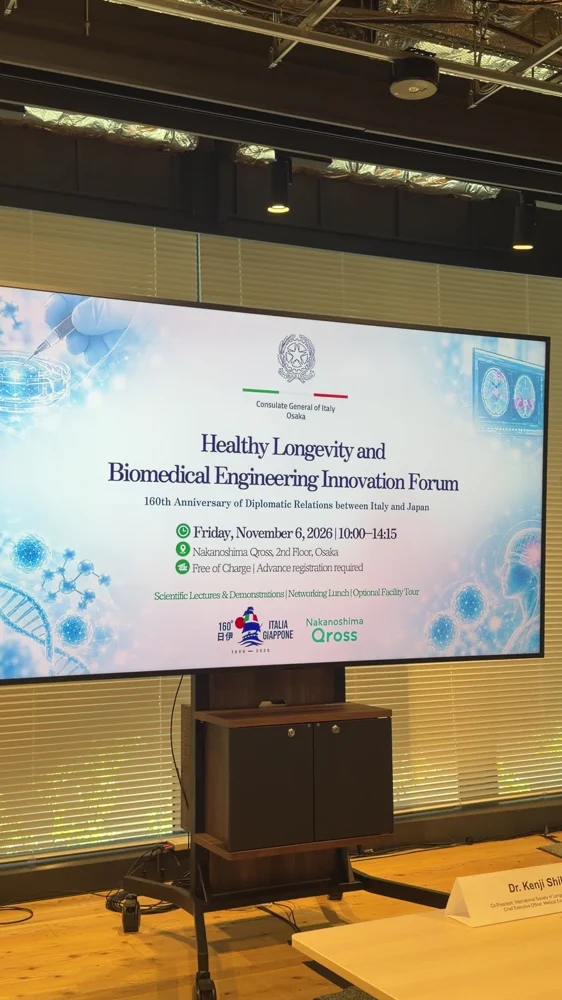
Two countries, one shared question
The programme opened with Consul General Filippo Manara and a keynote by Professor Yoshiki Sawa. Researchers from Politecnico di Torino joined the Japanese participants; Dr Kenji Shibuya, co-president of the International Society of Longevity Medicine and Wellness and CEO of Medical Excellence JAPAN, was also on the programme.
For us, the interesting shift was from longevity as a number to the capabilities that make a longer life worthwhile. How do we understand a change earlier? How do we preserve function? Which tools can make care more useful in daily life? Those questions gave the technical sessions a human context.
Devices, tissue models and intelligent technologies
Professor Alberto Audenino’s scheduled topic linked implantable medical devices with regulation and cost. Professor Gianluca Ciardelli brought together biotechnology and nanotechnology through organ and tissue models. Professor Filippo Molinari addressed intelligent technologies across different biological scales.
Together, these themes offered a useful way to read the field. A device needs a path into care. A tissue model needs to answer a meaningful question. A computational tool needs to be judged by what it helps a clinician or researcher understand.
We left with a reading list rather than a single headline: look more closely at the model, the measurement and the intended use. That is where an ambitious technology becomes easier to assess.
Seeing, testing and delivering differently
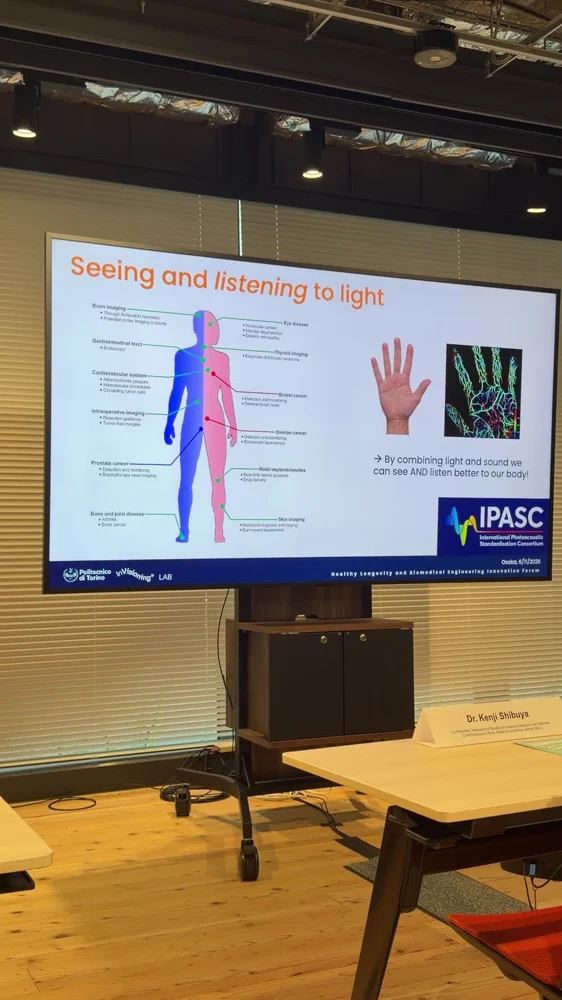
The demonstrations added three perspectives: Professor Mara Terzini on preclinical testing of surgical devices, Professor Chiara Tonda Turo on injectable hydrogel platforms, and Professor Kristen Mariko Meiburger on imaging approaches that combine light with sound.
Our recording of the final imaging presentation captures the phrase “Seeing and listening to light”. It is a memorable invitation to think about the body through different signals, and about what each measurement can reveal.
This was one of the most engaging threads of the day: different technologies are useful because they answer different questions. Understanding that purpose is the starting point for understanding their promise.
Seeing and listening to light
The conversations we want to continue
Networking was part of the programme, followed by closing remarks from Professor Pezzotti and an optional facility tour. That space for exchange mattered alongside the lectures: a forum can connect disciplines that usually work with different methods and vocabularies.
At YOTSUBA JAPAN, our interest in healthy longevity begins with everyday life: remaining active, curious and able to take part. Attending these events helps us ask more informed questions about the wider scientific landscape in which we work.
The October meeting with Denmark focused our attention on the route from discovery to development. This Japan–Italy forum widened that view to the tools that help us observe, test and support human function. We will continue sharing the ideas that deserve a closer look.