Inspired by The Health Industry News, No. 1845 · 7 October 2026, pp. 41–42, with ingredient documentation and published research.
Ginger, transformed by fermentation.
Inside ginger koji: a familiar rhizome, a Japanese fermentation culture and a different ingredient profile.
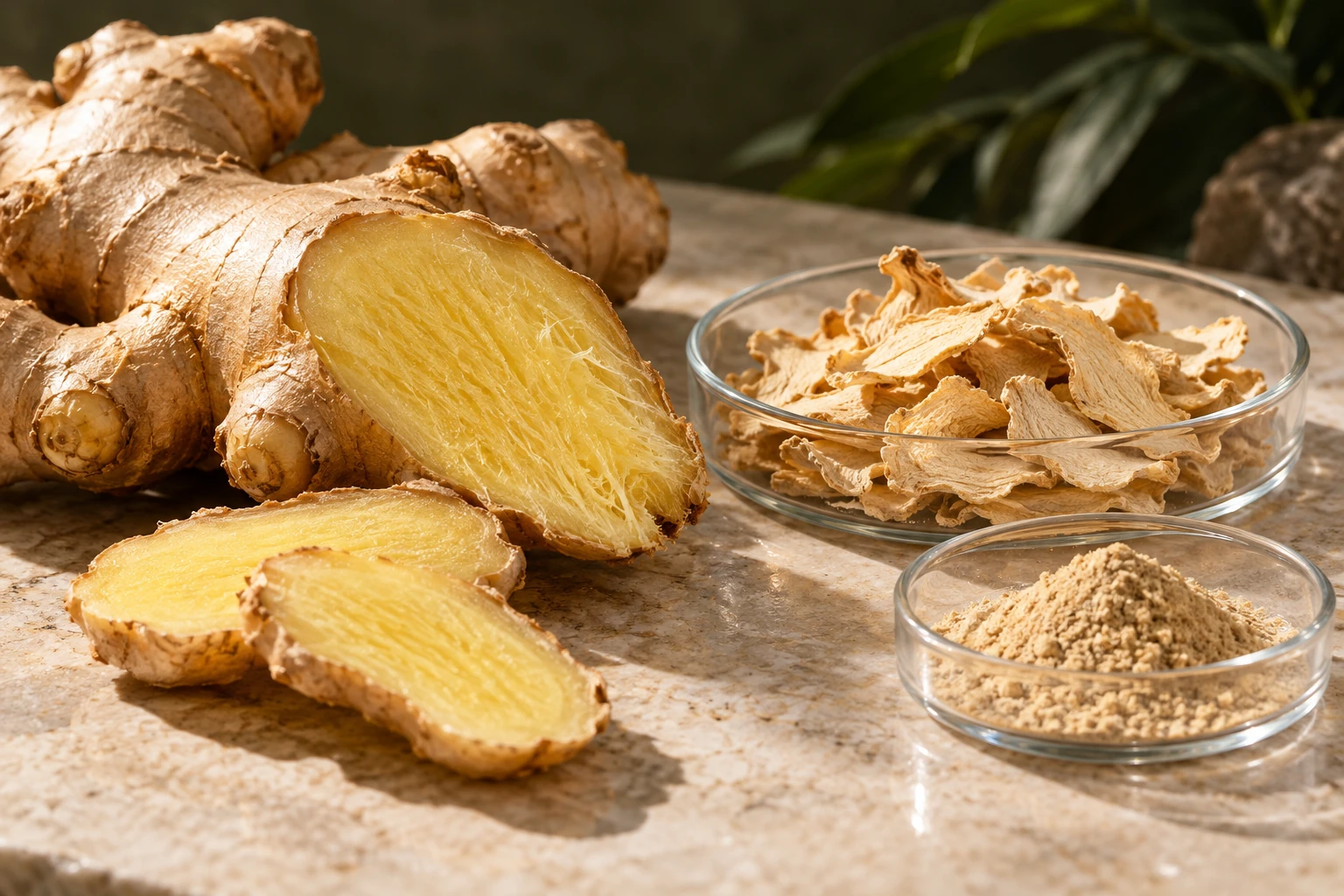
Cut into fresh ginger and its character is immediate: a bright aroma, a fibrous golden interior and a distinctive pungency. In the kitchen, those qualities are familiar. In ingredient development, they invite a further question: what happens when the plant becomes a substrate for fermentation?
Ginger koji brings that question into focus. It connects a recognisable botanical with a controlled biological process. The resulting ingredient has a story that extends beyond its plant name, through the way it is prepared, analysed and studied.
A botanical becomes a fermentation substrate
Ginger chips
The plant material provides the solid substrate for cultivation.
Koji cultivation
Aspergillus oryzae grows on the prepared ginger under controlled conditions.
Prepared powder
Drying and milling yield a material whose composition and enzyme activity can be assessed.
What the warmth experiment actually measured
- 5 women
A small crossover experiment
Yukina Kawabata, Misato Kanaoka and colleagues; Department of Biosphere Sciences, Kobe College, with industry coauthors. Published in 2013.
- 500 mg
A single experimental serving
Ginger koji, ginger powder and cellulose placebo were evaluated on separate study occasions.
- 20°C · 1 min
A controlled hand-cooling challenge
Cooling began 20 minutes after intake. Researchers followed recovery of hand skin temperature.
A culture working on ginger
In the preparation described in published research, Aspergillus oryzae grows on ginger chips through solid-state fermentation. The ginger itself is the substrate. This distinguishes the studied ingredient from a kitchen seasoning made by blending ginger with rice koji.
The ingredient presentation reviewed by Yotsuba follows a sequence of water absorption, heat treatment, cooling, koji cultivation, drying, milling and sieving. Each stage contributes to the identity of the finished powder. Fermentation is a process with defined conditions, rather than a single specification shared by every fermented food.
From pungency to a chemical profile
Gingerols and shogaols are among the compounds that give ginger its pungent character. Their balance can change during processing. A controlled food-science study comparing heating conditions found that temperature, time, moisture and the form of the starting material all influenced conversion of gingerols to shogaols.
The ginger-koji documentation also describes a changed pungent-component profile after processing. Reading that result well means considering the whole preparation, including its heating and drying steps alongside cultivation. A higher concentration of one component describes composition; its significance for human health requires a separate investigation.
The enzyme dimension
The technical presentation reports alpha-amylase and protease activity in the ginger-koji powder. Alpha-amylase acts on starch; proteases act on proteins. These measurements add an enzymatic dimension to the botanical profile.
One experiment in the presentation combined the powder with milk protein in simulated gastric fluid and measured released amino acids. This is a useful way to investigate protein breakdown under defined laboratory conditions. It does not directly measure nutrient absorption in people, nor does it establish improved digestion from a finished capsule.
Fermented also describes how a material was made. It does not, by itself, tell us that a product contains live probiotic microorganisms. Culture viability and retained enzyme activity are different properties, each requiring its own specification.
A small study of warmth
A 2013 double-blind, placebo-controlled crossover study examined five young women with cold-sensitive fingertips. It compared a single 500 mg serving of ginger koji with ginger powder and cellulose placebo. After a brief hand-cooling challenge, researchers followed skin-temperature recovery. They reported higher recovery with ginger koji than with placebo; a separate condition also examined a milk-protein drink.
This is an interesting early human observation, with a narrow outcome and a very small sample. It measures short-term peripheral skin-temperature recovery, rather than lasting changes in core body temperature, circulation disorders or weight loss. It does not establish that every fermented ginger preparation produces the same result.
The place of ginger koji in a formula
Within the Yotsuba collection, ginger koji appears in Fermented Ginseng alongside fermented Panax ginseng extract and fermented black garlic. These are distinct ingredients brought together in one composition. Ginger koji is not another name for fermented ginseng, and ginger oil belongs to a different ingredient category.
The published experiment used 500 mg of the studied ginger-koji preparation. Our complete formula has its own serving composition and has not been evaluated in that experiment. The product page lets readers examine those details in context, with the full ingredient declaration.
Follow the ingredient, then the formula
Ginger koji offers a precise way into the wider subject of fermentation. Begin with the source material, follow the production process and look at what was measured in the resulting ingredient. Then consider how that ingredient fits within a complete product.
Our Fermented Ingredients collection brings together other materials shaped by fermentation. Each ingredient opens a route to the Yotsuba products that contain it, so readers can explore the connection between raw-material craft and formulation at their own pace.
Discover the formula containing ginger koji, or follow the wider collection from fermented ingredients to the products that use them.
Explore Fermented Ingredients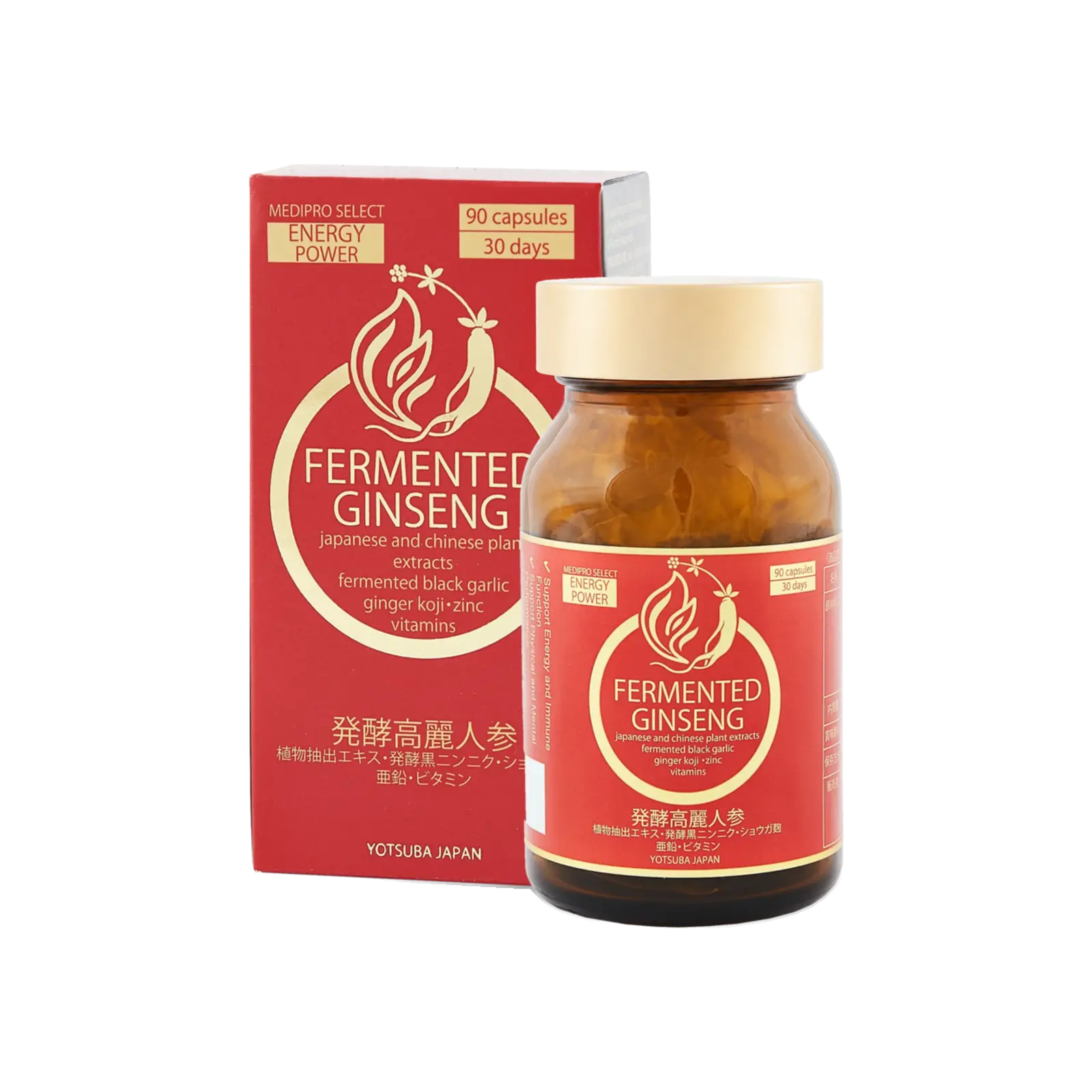
Ingredient process and enzyme context: technical presentation reviewed by Yotsuba Japan. The linked human study concerns a particular raw material and experimental dose, not the complete Yotsuba formula. The reported 500 mg is study context, not a product-use recommendation.