Based on The Health Industry News, issue 1844, 16 September 2026, ingredient documentation and scientific publications.
Lutein. From golden petals to vision science.
Marigold flowers, deep-purple berries and the research that connects nutrition with the way we see.
Morning messages on a phone. Documents, photographs and a computer screen throughout the day. In the evening, a book — or the journey home through the light of passing headlights.
Our gaze moves constantly between objects, distances and changing light. The quality of vision is made up of many details: how well we distinguish shades and contrasts, how we respond to bright light, and how comfortable our eyes feel after a long day.
These everyday questions help explain scientific interest in lutein — a yellow plant pigment also found in our eyes.
Why lutein?
Lutein and the closely related pigment zeaxanthin accumulate in the central region of the retina. This small area helps us read, recognise faces and see fine details.
The pigments absorb part of the short-wavelength visible light spectrum and take part in protection against oxidative processes. The human body does not make them: we obtain them from food, including green vegetables and egg yolks.
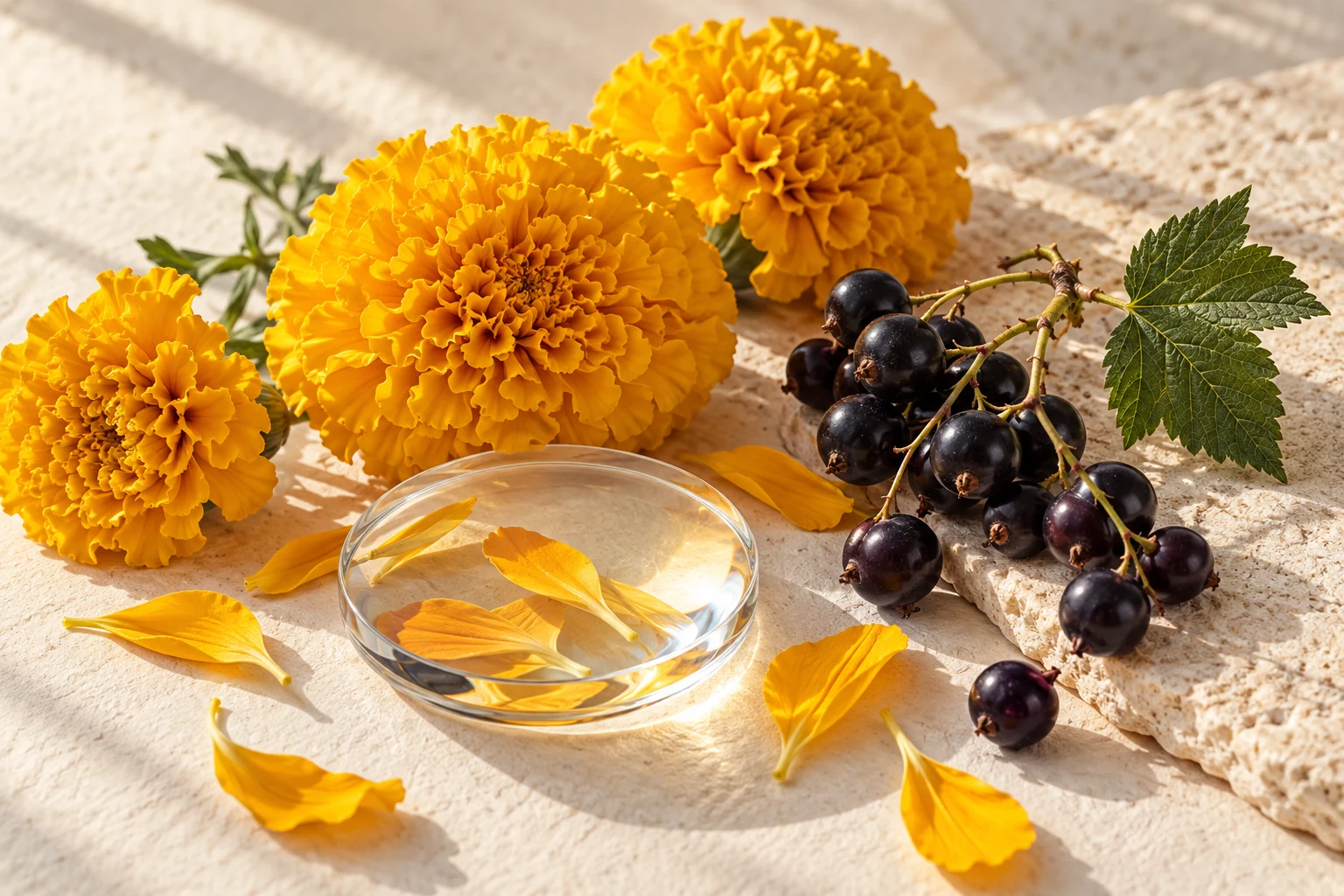
Lutein used in food supplements has another distinctive source — the golden flowers of marigolds.
The story begins with a flower
Marigold flowers are the source of the lutein ingredient described in the documentation for our Marigold Lutein formula.
The petals pass through several processing stages to produce an ingredient with a defined lutein content. In the supplied materials, it is called Lyc-O-Lutein™.
Behind a short line on an ingredient list lies a whole story: selecting a plant, extracting its pigment, preparing the material and checking the result. The vivid colour of a flower becomes part of a contemporary formula.
What researchers are asking today
Scientists examine different aspects of vision, from age-related changes in the retina to visual comfort in everyday life.
In an Australian study published in 2025, Adrian Lopresti and S. J. Smith followed 70 adults who spent more than six hours a day using screens. For six months, participants received lutein and zeaxanthin or a placebo.
They measured how quickly vision recovered after bright light and how stable the tear film remained on the eye’s surface.
Some objective measures improved more in the carotenoid group. Participants’ own ratings and contrast sensitivity did not differ between groups. The study used a different ingredient preparation, so the findings help explain this research direction while remaining specific to the composition tested.
Everyday screen use. Measured over time.
- 70 adults
A day with screens
Participants used screens for more than six hours daily.
- 6 months
Two study groups
A randomised, double-blind comparison with placebo.
Golden flowers and purple berries
In Marigold Lutein, the story continues with berries.
Blackcurrant, maqui and blue honeysuckle contain plant polyphenols. These include anthocyanins, which give fruit rich red, blue and purple shades.
The supplied documentation describes Meiji AC10 blackcurrant extract as a source of a particular group of anthocyanins. The blue-honeysuckle materials introduce another berry ingredient in the composition.
Lutein and berry polyphenols belong to different families of plant compounds. Bringing them together gives Marigold Lutein a broader composition than its name alone might suggest.
Golden petals. Deep-purple berries.
Marigold flowers
The botanical source of the lutein ingredient.
Berry pigments
Anthocyanins form part of the polyphenol story.
A formula with several stories
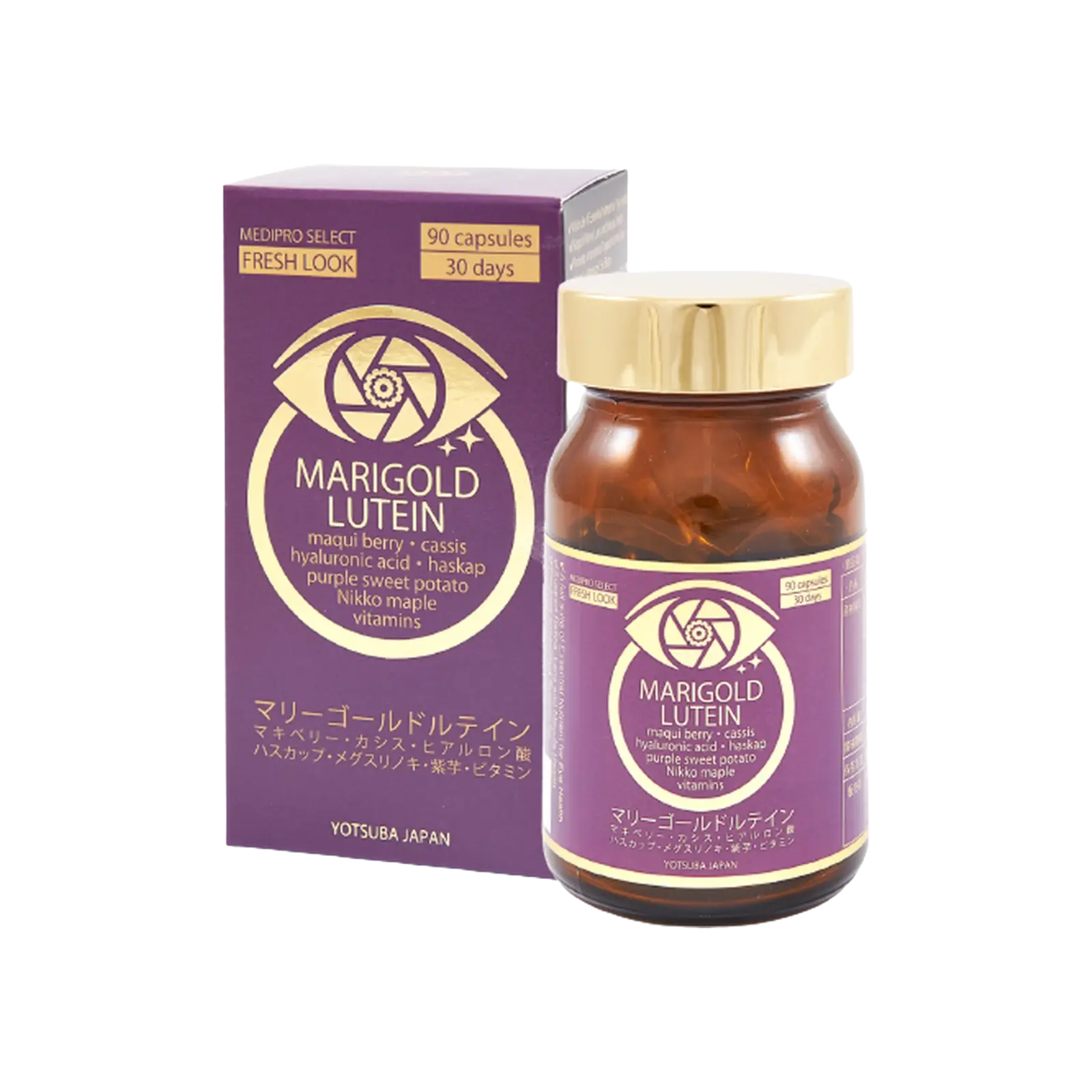
Yotsuba Japan Marigold Lutein combines marigold-derived lutein with berry extracts, purple chrysanthemum, purple sweet potato and other ingredients. Hyaluronic acid and vitamins A, E, B6 and B12 complete the composition.
Golden petals and dark berries give the formula its character. Scientific research helps us ask precise questions about its ingredients — and gradually understand more about the relationship between nutrition and vision.
Explore the complete botanical composition of Yotsuba Japan Marigold Lutein.
The human study discussed used a different ingredient preparation. It did not test the complete Yotsuba formula.