How glycation changes our collagen.
What happens to the protein framework already in our tissues — and why Japanese researchers are looking beyond sugar alone.
Collagen can remain in a tissue and still change
When we discuss skin firmness, we often ask how much collagen we obtain. Another question deserves attention: what happens to the fibres that are already there?
Glycation connects the chemistry of sugars with the properties of protein structures. Japanese research considers this subject more broadly than the familiar pairing of sugar and ageing: attention also turns to intermediate compounds involved in modifying proteins.
What happens during glycation
During glycation, sugars and their reactive derivatives interact with proteins without the involvement of enzymes. A sequence of chemical transformations can produce advanced glycation end products, or AGEs. These compounds have different properties; some create additional cross-links within or between proteins.
Imagine a protein structure developing extra bridges. They change how its parts interact. For collagen, this can affect mechanical properties and make the protein less accessible to enzymes involved in its breakdown. The process develops over time and depends on the conditions around the protein and how long it remains in the tissue.
How additional bridges can form
Protein structure
Collagen is part of the existing tissue framework.
Chemical modification
Sugars and reactive derivatives can modify proteins.
Additional cross-links
Some AGEs connect sites within or between proteins.
Why collagen attracts particular interest
In a study of human skin samples, researchers found that glucosepane, an important AGE cross-link, accumulated with age. Levels were higher in diabetes. This was an observation in human tissue, rather than a laboratory model alone.
Glycation is one contributor to changes in tissues. It does not explain every wrinkle, but it helps us understand why the condition of the protein framework deserves attention alongside the amount of protein present.
A Japanese perspective on glycative stress
The 1 April 2026 feature in the Japanese trade newspaper The Health Industry News, linked to print issue 1833, highlighted interest in compounds that can bind reactive aldehydes. This broadens the discussion beyond a single blood-glucose reading.
The industry overview noted that reactive compounds can arise through different metabolic processes involving sugars, lipids and alcohol. Methylglyoxal is one compound of interest in this field. Such substances can participate in the chemical modification of proteins.
Intermediate steps matter too
The research question becomes broader: can particular steps be influenced before end products accumulate? Binding reactive aldehydes is one approach discussed in the Japanese industry press. Interest in this mechanism does not, by itself, establish the effectiveness of an ingredient or a finished supplement.
Glycation and oxidation are connected, but different
Oxidative stress concerns an excess of reactive species relative to the capacity of protective systems. Glycation describes chemical modifications involving sugars and their derivatives. The processes can intersect, but calling a substance an antioxidant does not establish anti-glycation activity. Each question requires appropriate measurements.
What a study actually measures
Scientific studies can examine different things: AGE formation in a mixture of protein and glucose, a particular blood marker, or the properties of a tissue. These results are related, but not interchangeable. A lower laboratory signal does not mean that cross-links have disappeared from skin; glycated haemoglobin does not measure the condition of collagen.
This gives readers a useful guide: look beyond the term anti-glycation to ask which material was studied, what was measured and whether people took part. That is how an interesting mechanism can be distinguished from an established outcome.
Glycation brings greater depth to the discussion of beauty, directing attention towards tissue condition and metabolism. Plant compounds with a defined chemical identity and measurable activity are among the materials being investigated.
From a scientific question to a botanical ingredient
One botanical investigated in the context of glycation is Kaempferia parviflora extract. This member of the ginger family has a dark-purple rhizome and is known as black ginger or kuro-ukon. Its characteristic polymethoxyflavonoids have become the subject of laboratory research.
In a 2014 study by Nakata and colleagues, the extract and isolated compounds inhibited the formation of fluorescent AGEs in an albumin–glucose model. Their effects on the enzyme SIRT1 were examined separately. In 2021, Communications Biology published a more detailed study of direct SIRT1 activation by one compound from the plant.
These are two lines of investigation: glycation and cellular regulation through SIRT1. They provide scientific context for interest in the extract, without demonstrating that it breaks existing AGE cross-links in human collagen.
The ingredient in our formula
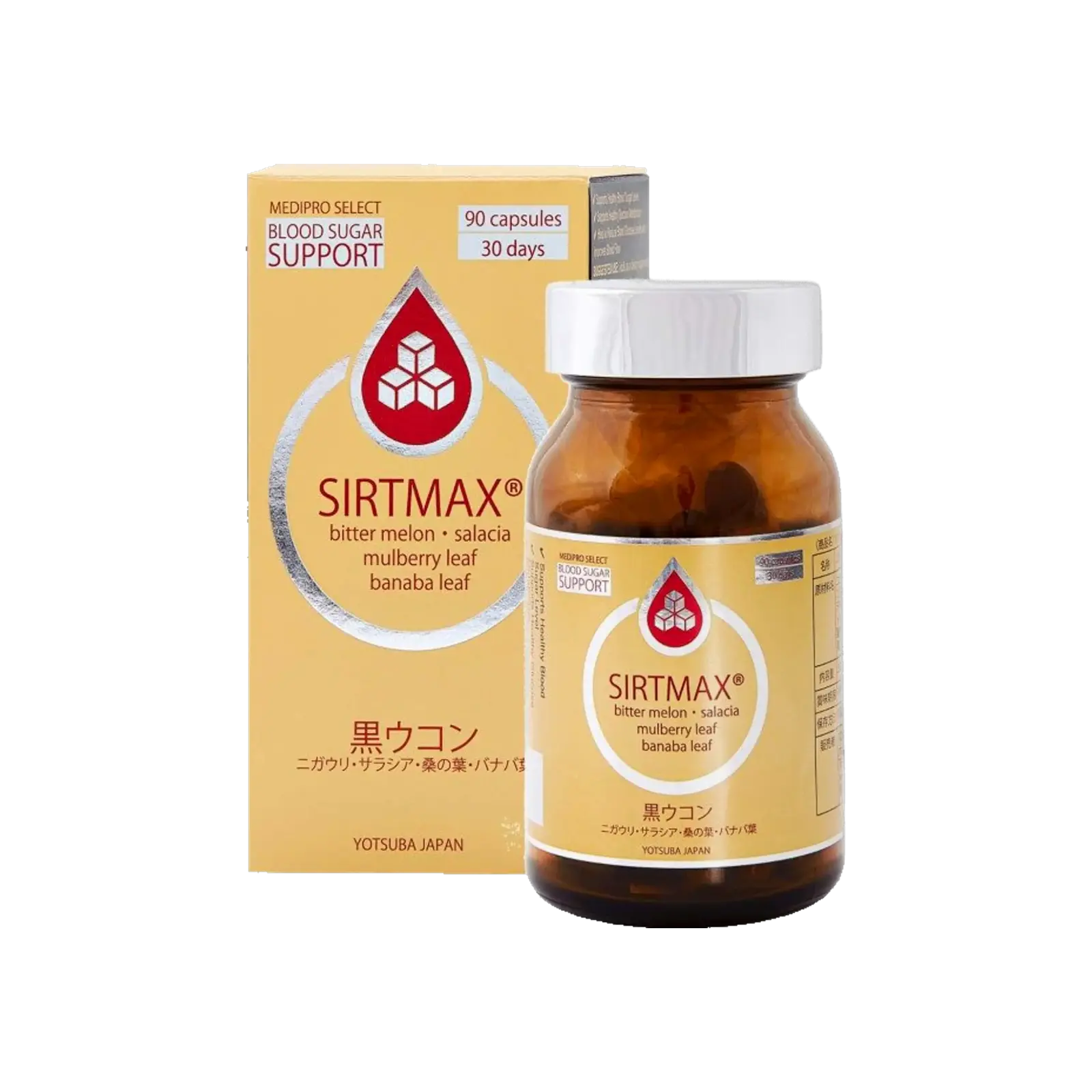
BLOOD SUGAR SUPPORT SIRTMAX® by Yotsuba Japan provides 100 mg of SIRTMAX® extract per three-capsule daily serving. The same daily amount of extract was examined in small human studies: seven weeks in a 2015 study involving 27 participants, and eight weeks in a 2019 study involving 28 participants. Researchers assessed measures of glucose metabolism.
These studies concern the ingredient and the preparations tested, rather than the complete Yotsuba Japan five-botanical formula. A matching extract amount helps readers understand the composition; it does not establish equivalent effectiveness.
The formula also includes bitter melon, Salacia and Banaba extracts, together with organic mulberry leaf powder. Its strengths are a specified, researched extract and a clearly quantified composition. The effectiveness of the combination needs to be assessed separately from studies of individual ingredients.
A closer look at the collagen already there
The condition of collagen belongs to a wider story about metabolism and tissue quality. Glycation helps us see that connection, while research on plant compounds explores which steps in the process may merit further investigation.
A food supplement does not replace medical treatment. People taking glucose-lowering medicines or receiving treatment for a chronic condition should discuss use with their healthcare professional.