Yotsuba Japan
All products

Women’s Daily Balance · 30-day system

HORMONE
BALANCESOY ISOFLAVONES AGLYCONE

A Japanese women’s wellness formula combining 30 mg of soy isoflavones in aglycone form with wild yam, pomegranate, a lactobionic-acid fermented ingredient, seaweed calcium and vitamin D.

180tablets6per dayMade in Japan
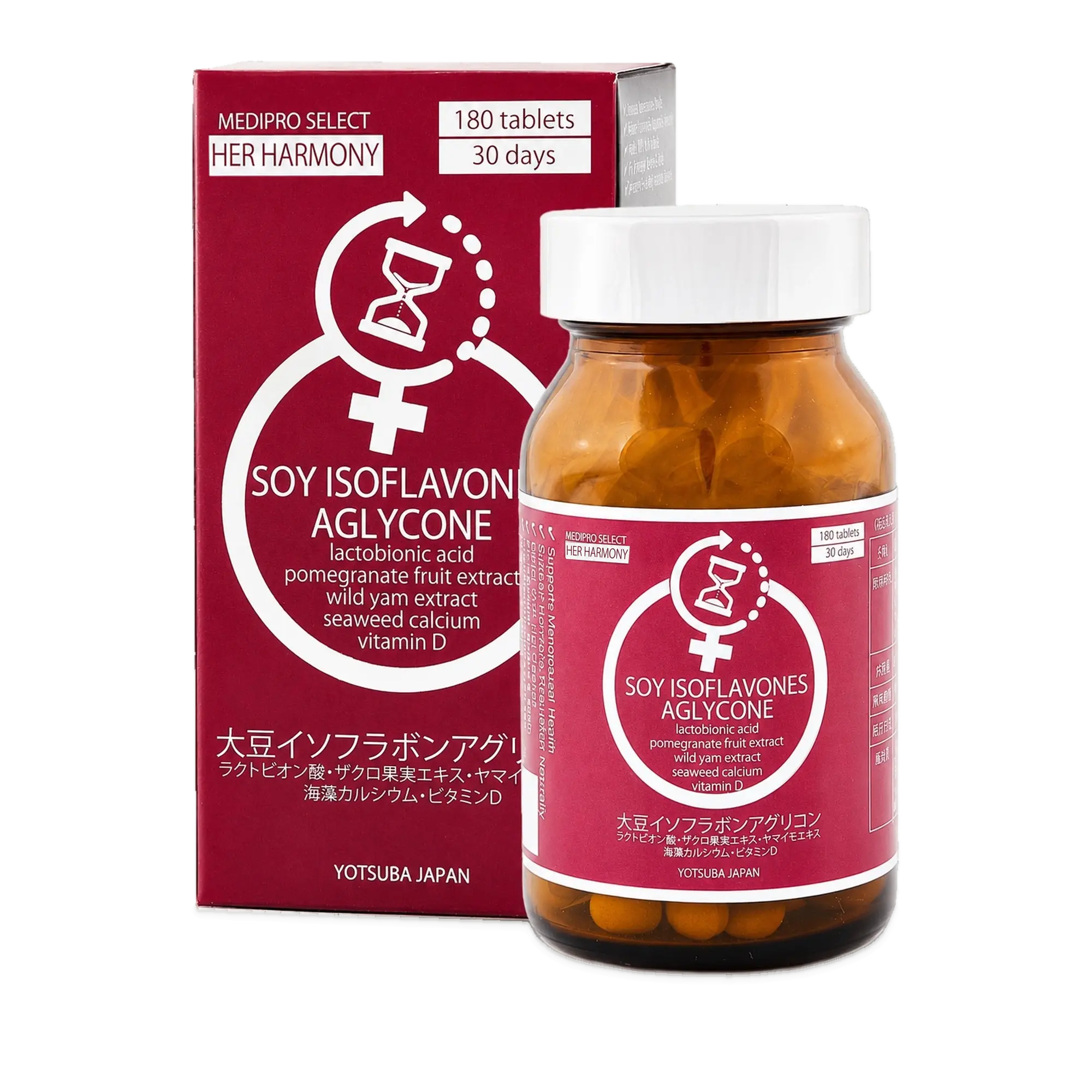
Her Harmony Soy Isoflavones Aglycone box and bottle by Yotsuba Japan

Why it was created

A thoughtful daily ritual
for changing life stages.

The formula is centred on soy isoflavones in the aglycone form, quantified at 30 mg per six-tablet daily serving.

Five complementary botanical, fermented and mineral ingredients create a broader women-focused nutrition concept for peri- and post-menopausal portfolios.

Soy aglycone · botanical layer · calcium & vitamin D
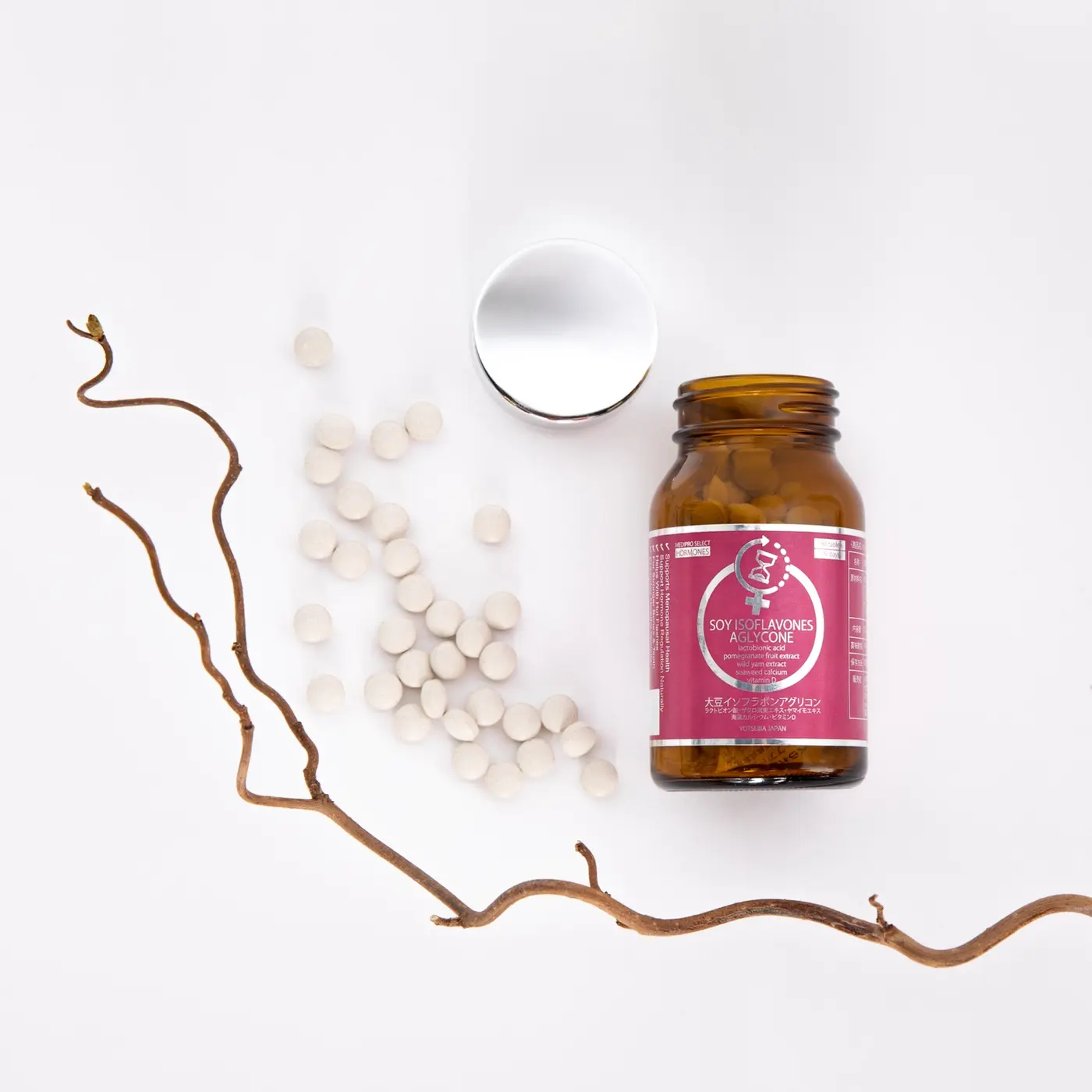
Hormone Balance bottle and tablets arranged in a clean pearl-white flatlay

Biochemistry · receptor context

A plant-derived structure.
A context-dependent signal.

Explore why molecular structure matters when isoflavones are discussed in relation to estrogen receptors.

Explore ingredient evidence
YOTSUBA JAPAN FORMULA STUDY
Aglycones are isoflavone forms without the attached sugar group of their glycosides. Isoflavones can interact with estrogen receptors; interaction varies by compound and receptor subtype. Receptor subtype, tissue, dose and individual biology all influence the response. General biological context, not a clinical result for this supplement. Simplified and not to scale.ER
01/ 03

Aglycone form

Aglycones are isoflavone forms without the attached sugar group of their glycosides.

General biological context, not a clinical result for this supplement. Simplified and not to scale.

Inside the formula · per 6-tablet daily serving

One aglycone core.
Five complementary layers.

The current Japanese label declares 30 mg soy isoflavone aglycone per daily serving. Individual quantities of the complementary ingredients are not declared.

Select an ingredient to explore its source or food comparison

Soy isoflavones · Tofu

Plain tofu illustrating the reference food, not the calculated portion

≈ 123–175g

of tofu, on an isoflavone aglycone-equivalent basis

Four Japanese reference samples · aglycone equivalents, not already-free aglycones

Calculation & source

The Food Safety Commission of Japan, Table 1 (2006), reports 17.1–24.3 mg soy isoflavone aglycone equivalents per 100 g tofu in four samples. 30 ÷ 24.3 × 100 to 30 ÷ 17.1 × 100 ≈ 123–175 g. The analytical values were obtained after acid hydrolysis. They do not mean tofu already contains the same amount in the free aglycone molecular form.

This compares selected constituent content, not complete nutrition, digestion, absorption or health effects. Composition varies with source and processing. Images are illustrative, not measured portions or eating recommendations. This is a historical food-composition reference, not identical molecular form, absorption timing or hormonal activity.

Food Safety Commission of Japan · Table 1 · PDF p. 15

Food quantities compare selected constituent content only. Form comparisons explain the relationship between a familiar source and a prepared ingredient; they do not imply a portion or extraction ratio. Foods and supplements differ in nutrition, absorption and health effects. Images are illustrative, not measured portions or eating recommendations.

Soy isoflavones aglycone: ingredient perspective open
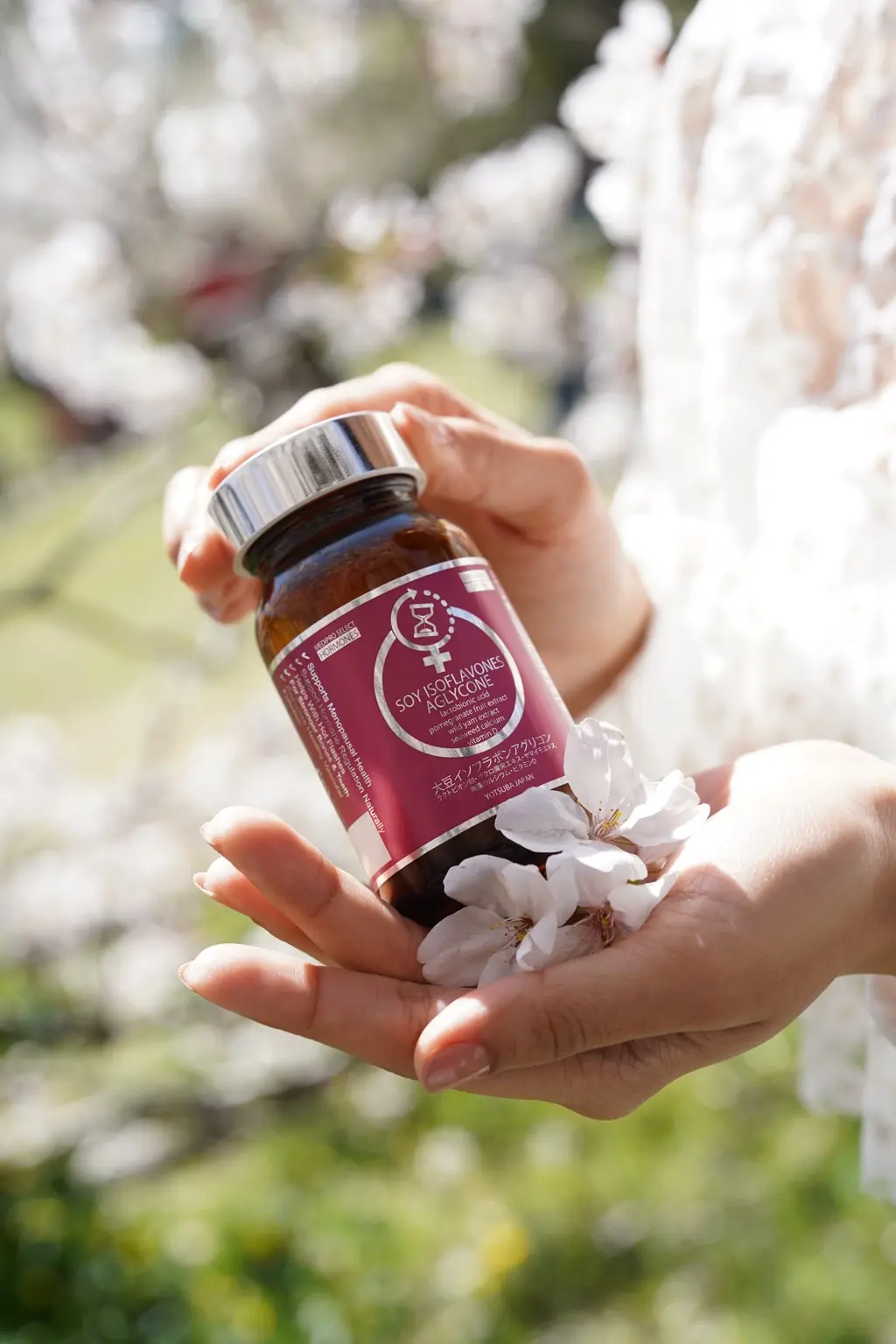
Hormone Balance bottle held among spring cherry blossoms in Japan

The women’s daily ritual

Quiet consistency,
six tablets a day.

A measured 30-day presentation turns a layered formulation into a simple daily routine. The editorial cherry-blossom setting reflects Japanese provenance without changing the product’s authentic packaging.

Six tablets dailySix formula componentsThirty-day presentation

Ingredient evidence library

Evidence, with the
right boundaries.

Important distinctionThe references below concern individual nutrients, isoflavone formats or supplemental isoflavones. They are not clinical trials of the complete Yotsuba Japan HORMONE BALANCE formula.
Soy isoflavone aglyconesIn-vitro receptor study

Receptor interaction depends on molecular form

Human estrogen-receptor binding assays found that soy isoflavone aglycones can interact differently with ERα and ERβ. This mechanistic evidence does not predict an individual response or show that the finished formula normalises hormone levels.

Human receptors · mechanistic evidence · not a product trialOpen source
Isoflavone formHuman pharmacokinetic study

Aglycone and glycoside formats

A human study compared soy isoflavone aglycones with glucosides and reported differences in absorption timing and exposure. The tested preparations and doses differ from this complete Yotsuba Japan formula.

Human · format comparison · different preparationsOpen source
Soy isoflavonesEFSA risk assessment

Peri- and post-menopausal use

EFSA reviewed supplemental isoflavone safety for peri- and post-menopausal women. This is a risk assessment, not proof that the finished product treats menopausal symptoms.

Calcium + vitamin DNIH nutrient reference

A complementary nutrient pairing

NIH explains that calcium is a structural component of bones and teeth and that vitamin D is required for active intestinal calcium absorption. The product label does not state an elemental calcium amount.

Nutrient reference · not a finished-product trialOpen source

Professional product data

Complete details,
clearly organised.

Professionals can review the complete Japanese ingredient declaration, allergens, format, nutrition, directions and handling information below.
Complete ingredients & allergens01

Current Japanese composition: Seaweed calcium (manufactured in the United Kingdom), wild yam extract, lactose-fermented product containing lactobionic acid, pomegranate fruit extract powder, maltitol, soy isoflavone extract containing aglycones, crystalline cellulose, silicon dioxide, calcium stearate and vitamin D.

Allergen information: Contains milk and soybean. The approved destination-market label remains authoritative.

Format & daily serving02
Format 180 tabletsDaily serving 6 tabletsSupply 30 daysNet content 63.0 gTablet weight 350 mgDaily serving weight 2.1 g
Nutrition per daily serving03
Energy 6.13 kcalProtein 0.01 gFat 0.07 gCarbohydrate 1.37 gSalt equivalent 0.008 gSoy isoflavones aglycone 30 mg

Values are stated on the current Japanese package per six-tablet daily serving (2.1 g). No individual quantities are declared for the other ingredients.

Use, storage & precautions04

Take six tablets daily with water or warm water. Store away from high temperature, humidity and direct sunlight. If the product does not agree with your constitution, reduce the amount or discontinue use. People taking medicines or receiving medical care should consult a physician before use. Consume promptly after opening. Natural variations in colour may occur without affecting quality. This is a health food product, not a medicine.

日本GMP
PRODUCTION

Japanese quality & provenance

Developed as a complete
30-day women’s system.

The 180-tablet presentation is produced in Japan under the GMP manufacturing standards declared on the current product packaging.

Frequently asked

Clear answers,
without overclaiming.

01What is “aglycone”?+

In soy, isoflavones can occur attached to a sugar group as glycosides. Aglycone describes the corresponding sugar-free molecular form. The animation on this page is conceptual and is not a simulation of absorption.

02What is the daily serving?+

The current Japanese directions indicate six tablets per day with water or warm water. Follow the approved destination-market label.

03What amount is declared on the Japanese package?+

The current Japanese package declares 30 mg of soy isoflavones aglycone per daily serving of six tablets. It does not state individual quantities for the other ingredients.

04What allergens are declared?+

The current Japanese ingredient declaration identifies milk and soybean. The approved market-specific label remains authoritative.

05Who should seek professional advice?+

Anyone who is pregnant or breastfeeding, receives medical care, takes medication, or has a hormone-sensitive medical history should consult an appropriate healthcare professional before use.

Food supplement · Not a medicine

Product information is educational and intended for professional portfolio review. It is not medical advice and is not intended to diagnose, treat, cure or prevent disease. Suitability, permitted claims and labelling must be assessed for each destination market.

HORMONE BALANCE · Women’s Daily Balance

A precise aglycone core,
shaped into a daily ritual.

Detailed product documentation is available to verified clinics, professionals and authorised partners, subject to individual review.Available exclusively through authorised Yotsuba Japan partners.

Restricted professional access

Request professional
product information.

Detailed product documentation is released only after review by Yotsuba Japan or an authorised partner.
01 Your details
02 Your request